

PR Application
EP to PR Pathway Guide 2026
Learn the realistic timeline for EP to PR transition in Singapore, including eligibility criteria, application steps, documents needed, and what ICA actually evaluates beyond salary.
Last updated: March 2026
You've landed your dream role on an Employment Pass in Singapore. Now comes the natural question: "What's the EP to PR pathway in Singapore, and how does the process work?"
The short answer is you can technically apply after 6 months, but the smart timeline is 1-2 years. The longer answer is more complex and matters more for your success.
ICA doesn't publish approval rates, and outcomes depend on factors well beyond your salary. Every application is assessed individually.
This guide covers the realistic EP-to-PR timeline, what ICA evaluates, and how to position yourself for a strong application.
Can EP holders apply for PR?

Yes. According to the Ministry of Manpower, "Employment Pass holders can apply to become permanent residents. The application is assessed by ICA based on permanent residence criteria." (See MOM's official FAQ on EP holders and PR)
The key phrase is "based on permanent residence criteria", not EP criteria. Your EP salary (currently S$5,600 minimum) is just one factor. ICA evaluates your qualifications, age, family ties, economic contributions, and ability to integrate into Singapore society.
EP holders apply under the Professional Technical and Skilled (PTS) Worker Scheme, designed for work-pass holders seeking PR. You're in the right category. You need to show you meet PR criteria. For official details, visit the ICA's PR page.
When can you apply for EP to PR in Singapore? The 6-month minimum vs. the 1-2 year sweet spot
ICA doesn't publish a formal minimum tenure requirement, but MOM's FAQ implies a 6-month threshold. Technically, you can apply 6 months into your EP.
Most immigration consultants recommend waiting 1-2 years instead. Here's why.
The 6-month minimum shows sustained employment and commitment. But it's too early to demonstrate economic contribution or integration. You haven't completed a full year of CPF contributions, renewed your EP, or established a solid work history.
The 1-2 year timeframe works better for most successful applicants. By then, you've:
- Built a salary progression trajectory (even a 5-10% raise signals stability)
- Completed annual performance reviews (if applicable)
- Paid meaningful CPF contributions
- Demonstrated work history in Singapore
- Shown ability to integrate (community involvement, language skills, family ties)
Salary progression matters. A salary of S$6,500 after two years on your EP looks stronger than S$6,500 at the start. Progression shows economic growth and employer confidence. A 5-10% annual increase is typical and signals career stability.
Strategic timing for job changes during PR planning:
- Best scenario: Apply for PR at 18-24 months on current EP, then consider job changes after PR approval
- Acceptable scenario: Change jobs at 18+ months, settle into new role for 6 months, then apply for PR
- Riskier scenario: Change jobs at 12 months or less, then immediately apply for PR (triggers additional verification, delays processing by 2-3 months)
The safest approach is to establish a stable employment record on your EP before changing jobs. If a strong opportunity comes up, discuss timing with an immigration advisor first.
What ICA actually evaluates: Beyond salary

Most people focus only on salary. ICA evaluates you across multiple factors.
According to ICA's official criteria, they assess:
- Family ties to Singapore — Do you have a spouse, children, parents, or siblings in Singapore? Stronger ties improve your odds.
- Economic contributions — Salary is one part. ICA also considers CPF payments, property investment, business ownership, and community involvement. As an EP holder, you contribute through taxes and CPF. Additional investments (HDB property, CPF growth) strengthen your application.
- Qualifications and expertise — A Bachelor's degree or higher helps. Specialist roles (tech, finance, healthcare, engineering) have higher approval rates than general positions. Postgraduate qualifications (Master's, MBA) strengthen your case.
- Age — Candidates aged 25-45 have the best approval odds. Younger applicants are preferred, though experienced candidates (45+) can still approve if they offer economic value.
- Character and integrity — Clean criminal record, no immigration violations, strong professional references.
- Ability to integrate — Language skills, community involvement, length of residence. Evidence of settling (enrolling children in local schools, community membership, language study) helps.
Sector-specific salary benchmarks for PR approval (general industry observation, not official ICA policy):
- Tech/IT: S$8,000–S$15,000 (high demand sector, COMPASS advantage)
- Finance: S$9,000–S$18,000 (premium sector)
- Healthcare: S$6,500–S$10,000 (essential sector, lower benchmarks)
- Engineering: S$7,500–S$14,000 (demand sector)
- General professional roles: S$7,000–S$10,000
These are guidelines, not fixed rules. A specialist earning S$7,500 with advanced qualifications might approve, while a generalist earning S$10,000 with basic qualifications might not. Sector and qualifications matter as much as salary.
Your COMPASS scorecard (from your EP application) shows ICA already assessed your salary, qualifications, and sector. Include it in your PR application to show consistency with EP approval standards.
Your step-by-step application process
Here's what the journey looks like after you decide to apply:
Application Journey
| Step | Action | Details |
|---|---|---|
| 1 | Verify eligibility | Confirm valid EP, 6+ months tenure, clean criminal record, residency requirements met |
| 2 | Prepare documents | Gather employment letter, payslips, tax records, COMPASS scorecard, passport, qualifications |
| 3 | Register Singpass | Create or update Singpass account at singpass.gov.sg for online submission |
| 4 | Submit via ICA e-Service | Upload documents, answer eligibility questions, pay application fee (S$150–200) |
| 5 | Await In-Principle Approval | ICA reviews (6–12 months), approved applicants receive IPA |
| 6 | Collect PR status | Visit ICA office (within 2 months of IPA), bring passport and IPA letter |
Step 1: Verify your eligibility
- You hold a valid EP (or have held one within the past 6 months)
- You've been in Singapore for 6+ months
- You meet basic residency requirements
- You have no serious criminal convictions
Use our PR application checklist to confirm you meet these requirements.
Step 2: Prepare your documents (EP-holder edition)
Unlike student or family-based PR applicants, you'll need documents specific to your employment:
- Current employment letter from your employer (official letterhead, confirming position, salary, tenure, and future employment prospects)
- Payslips from the last 12 months
- Annual tax notices and CPF contribution statements
- Passport and travel records (showing time in Singapore)
- COMPASS assessment scorecard (from your EP approval)
- Educational qualifications (degree, certificates, translations if needed)
- Dependent pass documentation (if you brought family to Singapore)
More on this in the next section.
Step 3: Register or activate Singpass
PR applications require Singpass authentication. Create or update your account at singpass.gov.sg.
Step 4: Submit online via ICA e-Service
Visit ICA's official website and submit your PR application through their e-Service portal. You'll upload all documents, answer eligibility questions, and pay the application fee (currently around S$150-200, depending on family size).
No physical submission needed. Everything goes online.
Step 5: Await in-principle approval (IPA)
After 6 months (or up to 12 months for complex cases), ICA will issue an In-Principle Approval. This means you've been approved subject to final formalities. You're almost there.
Step 6: Collect your PR status
Once you receive IPA, you have 2 months to visit an ICA office by appointment to collect your PR card and finalize formalities. Bring your passport and original IPA letter.
You're now a Singapore permanent resident.
What happens after you collect your PR card: CPF, REP, and housing
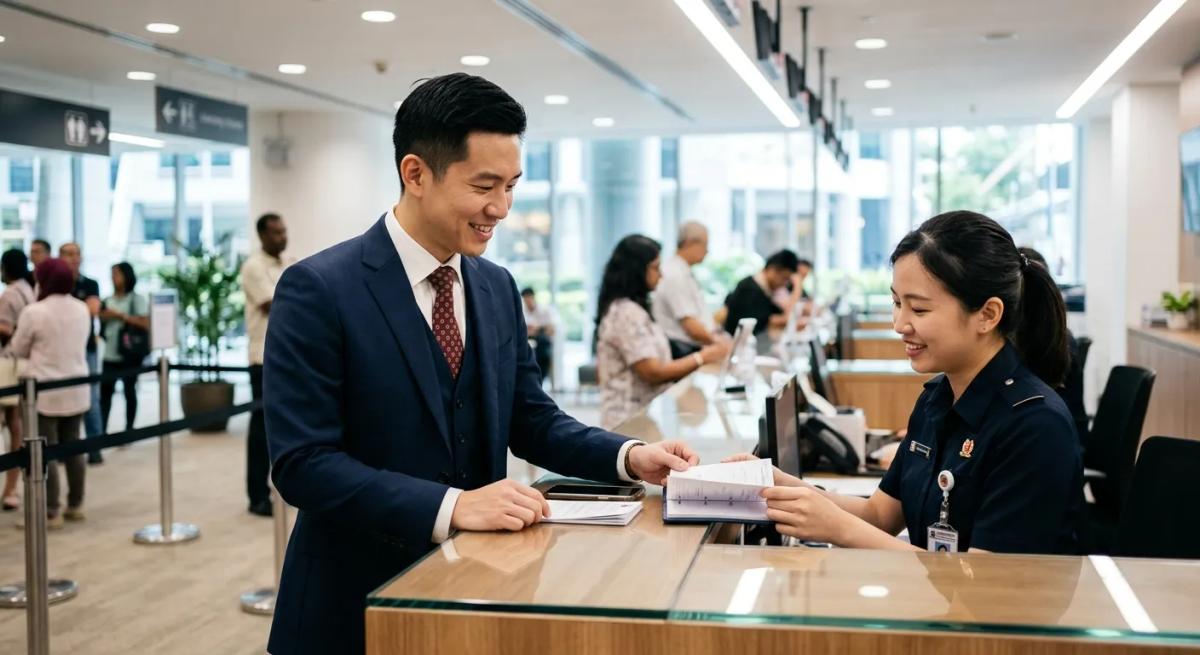
Once you collect your PR card, you'll need to manage several administrative changes. Here's what to expect:
CPF contribution rates change immediately. As a PR, your CPF contribution and withdrawal rules differ from EP holders:
- Your employer's CPF contribution follows a graduated schedule: 4% in Year 1 of PR status, 9% in Year 2, and the full 17% from Year 3 onwards
- Your own CPF contribution also increases gradually: 5% in Year 1, 15% in Year 2, and 20% from Year 3 onwards
- You're now eligible to withdraw CPF for HDB property purchases
- CPF withdrawal limits for non-housing purposes increase
Contact CPF Board (cpf.gov.sg) after collecting your PR card to activate your new rates and understand your housing eligibility.
Apply for a Re-Entry Permit (REP) if you plan to travel. This is often overlooked. If you leave Singapore for longer than 6 months without an REP, you may lose your PR status. You can apply for REP when you collect your PR card. An REP can be valid for 1-5 years.
HDB housing becomes available immediately. As a PR, you can purchase HDB properties with your CPF. Many EP holders use HDB purchases as evidence of "settling into Singapore" for future applications (e.g., citizenship). HDB eligibility requires some conditions. Review HDB's official eligibility criteria before viewing properties.
Dependent passes don't automatically convert. Family members on dependent passes don't become PRs when you do. They remain on dependent passes or can apply separately. Plan ahead for family conversions.
Documents EP holders need
All PR applicants need passports, education records, and tax documents. EP holders also need specific employment documentation.
The employment verification letter matters. ICA wants specific information:
- What's your exact job title and responsibilities?
- How much are you earning (monthly and annual)?
- Is your position permanent, contract-based, or fixed-term?
- What's the employer's view on your future (will they sponsor your PR)?
- Are there any performance issues or probationary concerns?
ICA verifies the letter directly with your employer. Here's what makes a strong employment letter:
- Signed on company letterhead by HR or direct manager (not generic template)
- Specific dates: Employment start date, current position start date, contract expiry (if applicable)
- Positive statement on your performance and value to the company
- Forward-looking language: "We intend to retain [Name] in this role" (demonstrates employer commitment)
- Detailed job description: Key responsibilities, not just title
- No red flags: Avoid mentioning probationary status, performance concerns, or pending contract reviews
Have your HR department draft the letter early (ideally 1-2 months before PR submission). Review it carefully and ensure it accurately reflects your role and salary. If anything seems off, request corrections before signing.
COMPASS scorecard. Your COMPASS score from your EP approval shows you met Singapore's professional standards. Include it to demonstrate consistency across both applications.
Dependent pass documentation. If you brought family on dependent passes, include their documentation. They don't automatically become PRs when you do. ICA assesses family applications together.
Employment history records. For EP holders with previous work visa history (e.g., prior S Pass holders), include documentation of continuous employment in Singapore. Gaps in employment raise questions about economic contribution.
Timeline: 6-12 months from application to approval
ICA typically takes 6 months for straightforward applications. But processing time varies.
Standard cases (6 months):
- No criminal history
- Complete documentation submitted upfront
- Single applicant or nuclear family
- No additional verification requests
Complex cases (up to 12 months):
- Multiple dependents
- Incomplete initial documentation (missing payslips, employment letters)
- Background verification needed (security checks)
- Additional information requests from ICA
After IPA is issued, you have 2 months to collect your PR status at an ICA office. Then it's official.
Total realistic timeline from application to holding a PR card: 8-14 months. Plan accordingly if you're job hunting or planning a move.
Common delays and how to avoid them:
- Outdated passport: Renew your passport before applying if it expires within 2 years.
- Incomplete employment letter: Work with HR early to draft the letter ICA expects.
- Missing tax records: Get your tax notices from IRAS upfront. Don't wait for ICA to ask.
- Dependent pass confusion: Clarify dependent pass status before submitting (expired? renewed? current?)
Does your EP salary guarantee PR?
No.
This is the most common misconception. Many applicants assume a salary of S$8,000 guarantees PR approval. Then they apply and get rejected.
The reality: ICA uses salary as a baseline, not a guarantee.
The EP minimum is S$5,600. Most EP holders earn S$7,000-S$15,000. For PR, ICA generally expects S$8,000-S$12,000+ depending on qualifications and sector. A specialist with a postgraduate degree earning S$7,500 might approve. A manager with a diploma earning S$10,000 might not.
ICA evaluates your entire profile. A strong application includes:
- Growing salary trajectory (not static)
- Relevant qualifications and credentials
- Sector importance (finance > retail)
- Family ties or community integration
- Positive employer reference
- Long tenure (2+ years > 6 months)
Strengthening an application below typical salary benchmarks:
- Highlight specialized skills or certifications
- Demonstrate community involvement or volunteer work
- Emphasize family ties (spouse in Singapore, children in local schools)
- Show salary growth progression
- Build a strong employment reference highlighting your value
If you're concerned about your salary, check our salary requirements guide for industry benchmarks. Remember: salary is one of six factors.
Common questions from EP holders considering PR
What if I change jobs during my PR application?
Job changes during application trigger additional verification. ICA may contact both employers, delaying processing to 9-12 months. Best practice: avoid job changes during application. If you must change jobs, notify ICA immediately with updated employment documentation.
What happens to my dependent passes when I get PR?
Dependent passes don't automatically convert. You need to apply for them separately. Plan ahead. Family conversions take time and additional documentation.
Can I apply for PR before my EP contract ends?
Yes, you can apply while your EP is valid or under renewal. But if your contract expires in 3 months and renewal is uncertain, wait until it's renewed.
What if my PR application is rejected? Can I reapply?
Yes. Most consultants recommend waiting 6-12 months before reapplying and addressing the rejection reasons. See our PR rejection guide for strategies.
How much should my salary increase before applying?
There's no fixed target. A 5-10% increase between year 1 and year 2 shows career growth. Focus on demonstrating progression rather than hitting a specific salary.
Does my COMPASS scorecard help my PR application?
Your COMPASS scorecard shows you met Singapore's professional standards for EP. Include it to show consistency across both applications.
Will taking time off work affect my PR chances?
Extended unpaid leave (more than 3 months) may raise concerns about employment stability. Paid leave is fine. Notify ICA if you take extended unpaid leave.
Can I expedite my PR application?
ICA doesn't offer expedited processing for PR applications. The standard timeline applies to everyone. Providing complete documentation upfront is the best way to avoid delays.
What happens to my CPF after I become a PR?
As a PR, your CPF contribution rates change. Your employer's contribution percentage increases, and you become eligible for CPF Housing withdrawal. Most PRs can start saving for HDB property ownership immediately after PR approval. The exact CPF transition happens after you collect your PR card—consult CPF Board (cpf.gov.sg) for current rates and housing eligibility.
What if my EP contract ends before I get my PR?
If your EP is expiring during application, renew your contract or notify ICA in writing. A gap in employment status can delay PR processing.
Do I need a Re-Entry Permit (REP) as a PR?
Yes, if you plan to travel. A REP allows you to maintain PR status while away. Without it, leaving Singapore for more than 6 months may result in loss of PR status. Apply for REP when you collect your PR card.
Should I inform my employer I'm applying for PR?
Not mandatory, but recommended. ICA may contact your employer during application. A conversation with HR ensures your employment letter is ready and they're prepared for ICA's questions.
Next steps
Here's what to do next:
Understand your EP: Read our Employment Pass guide for renewal requirements and salary context.
Check salary benchmarks: See our salary requirements guide for sector-specific standards.
Download your PR checklist: Get the itemized PR checklist at PR application checklist.
Ready to apply? We help EP holders navigate the entire PR process. Our team has guided hundreds through successful applications. Schedule a consultation to discuss your situation.
Disclaimer: This guide is based on official MOM and ICA guidance as of March 2026. Immigration policies change frequently. Always verify current requirements on mom.gov.sg and ica.gov.sg before submitting your application. For personalized advice, consult our team of specialists.
Go Deeper
Related Guides
Definitive Singapore PR Application Guide 2026
Complete guide to applying for Singapore Permanent Residence in 2026. Covers all 7 eligibility categories, required documents, step-by-step ICA e-Service process, fees, processing timeline, and what to do after approval.
Employment Pass Singapore: Complete Guide (2026)
Everything you need to know about Singapore's Employment Pass in 2026, including COMPASS scoring, salary thresholds by age, the step-by-step application process, and how to transition from EP to permanent residence.
Minimum Salary for PR in Singapore: What You Actually Need in 2026
There is no official minimum salary for Singapore PR, but your income still matters. This guide covers work pass salary floors, COMPASS C1 industry benchmarks by sector and age, and the non-salary factors that can make or break your application.
PR Application Checklist 2026: Complete Document Guide by Scheme
Complete checklist of documents needed for Singapore PR application in 2026 — PTS and sponsored applicants — with preparation tips and submission steps
Keep Reading
Related Posts
Does your salary affect your Singapore PR approval? [2026 Update]
Is there a minimum salary for PR in Singapore? Learn 2026 salary benchmarks by industry, EP and S Pass thresholds, and how to strengthen your application.
Singapore PR Application Success Factors (Updated for 2026)
Discover what ICA really looks for in PR applications. Learn the 6 key assessment factors, success strategies, and what applicants commonly overlook.
![Does your salary affect your Singapore PR approval? [2026 Update]](https://cdn.sanity.io/images/78z7uzbt/production/d34a367a63d725a09ea9c74508dd5dfc965cc229-1376x768.webp?w=720&auto=format&fit=max)