Living in SG
Buying Property in Singapore as a PR or Foreigner (ABSD, Rules & Costs)
A Singapore PR pays 5% ABSD on a first home while a foreigner pays 60%. This guide covers what PRs and foreigners can buy, current ABSD, BSD and SSD rates, financing limits and the full upfront cost.
Last updated: 25 August 2026
Rates current as of 25 August 2026 — verify with IRAS before you commit. Stamp duty rates, loan limits and cooling measures in Singapore change without much notice, sometimes overnight. Every figure in this guide is drawn from IRAS, URA, HDB, MAS and SLA, but you should confirm the exact rate that applies to your purchase on the official IRAS website (iras.gov.sg) and with your conveyancing lawyer before signing anything.
Yes, a Singapore Permanent Resident (PR) or a foreigner can buy property in Singapore. The real questions are what you are allowed to buy, and how much it costs once you add Additional Buyer's Stamp Duty (ABSD) on top of the price. For a PR buying a first home, ABSD adds 5% to the bill. For a foreigner, it adds 60%. On a S$1.5 million condominium, that single line item is the difference between S$75,000 and S$900,000.
This guide walks through the full picture: who can buy which type of property, the current ABSD and Buyer's Stamp Duty (BSD) rates by buyer profile, the reliefs that can bring ABSD down to zero, how much you can borrow, a fully worked example of the cash you need on completion day, and what you pay if you sell within four years. It also covers something the property portals rarely address, which is how owning a home in Singapore does (and does not) interact with your immigration status.
The search term absd singapore pr is one of the most common property queries in Singapore for a reason: the rules are strict, the numbers are large, and the penalty for getting it wrong is expensive.
ABSD Singapore 2026
The numbers that decide what a home really costs
5%
ABSD a PR pays on a first residential property
60%
Flat ABSD a foreigner pays on any residential property
0%
ABSD a Singapore Citizen pays on a first home
S$825,000
PR vs foreigner ABSD gap on a S$1.5m condo
Source: IRAS. Rates in force from 27 April 2023, current as of 25 August 2026. Verify at iras.gov.sg.
Can a PR or foreigner buy property in Singapore?
The short answer is that everyone can buy some Singapore residential property, but the type is gated by your status, and the cost is gated by how many properties you already own.
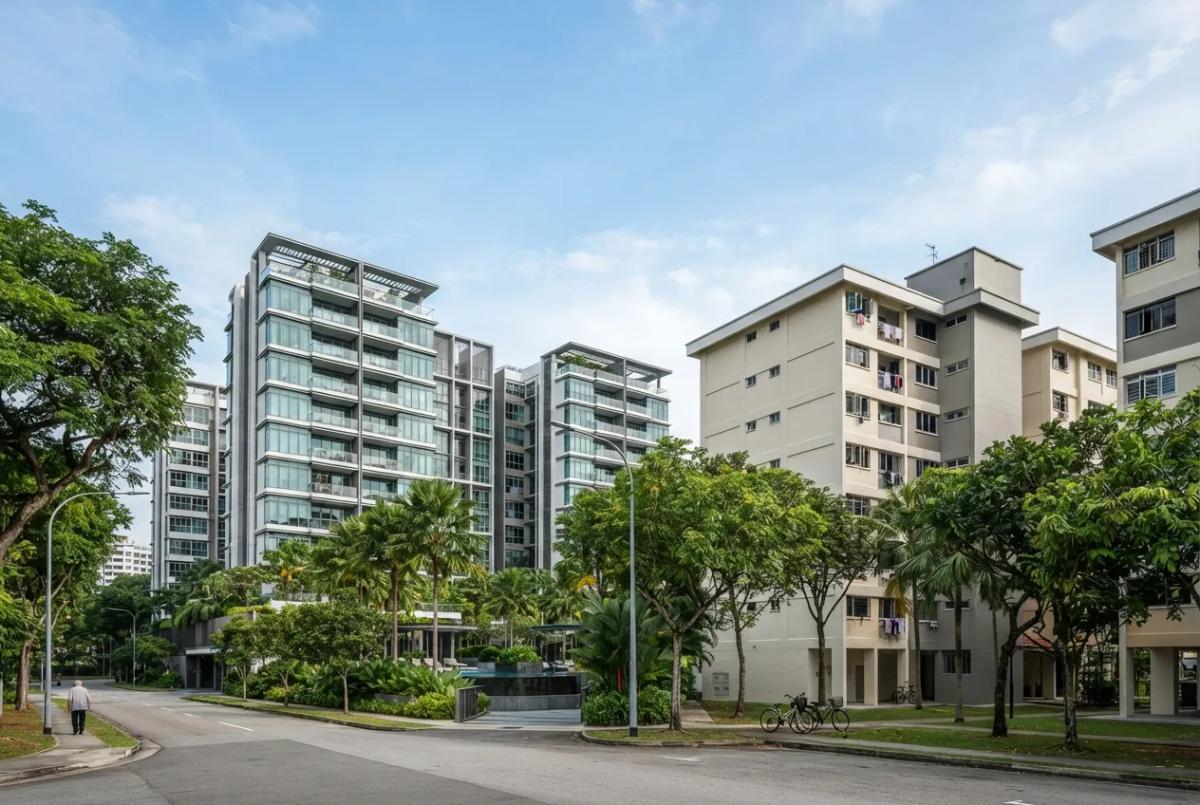
Singapore splits residential property into two legal buckets under the Residential Property Act, administered by the Singapore Land Authority (SLA):
- Non-restricted property: private condominiums, apartments in approved developments, and strata-landed homes inside an approved condominium project. PRs and foreigners can buy these with no special approval.
- Restricted property: landed houses (bungalows, terrace and semi-detached homes), vacant residential land, and strata-landed homes not within an approved condo development. Foreigners and PRs need government approval to buy these.
On top of that legal split sits the public housing system run by HDB, which has its own eligibility rules for PRs, and the stamp duty system run by IRAS, which sets ABSD and BSD by buyer profile.
The rest of this guide takes each layer in turn. If your main interest is HDB flats specifically, our dedicated guide on HDB eligibility for PRs goes deeper on quotas, grants and the family nucleus rules. For a wider view of what PR status gets you, see Singapore PR benefits.
What each buyer profile can buy
Before you look at price, work out which properties are even open to you. The table below sets out the position for the three main buyer profiles.
Who Can Buy What
| Property type | Singapore Citizen | Permanent Resident (PR) | Foreigner |
|---|---|---|---|
| HDB BTO (new flat) | Yes | No (unless married to a citizen) | No |
| HDB resale flat | Yes | Yes, after 3 years PR + family nucleus | No |
| Executive Condominium (EC), new from developer | Yes, subject to income ceiling | No | No |
| Executive Condominium (EC), resale after MOP | Yes | Yes | No (until EC is fully privatised, ~10 years) |
| Private condo / apartment | Yes | Yes | Yes |
| Strata-landed in approved condo project | Yes | Yes | Yes |
| Landed house (terrace, semi-D, bungalow) | Yes | Only with SLA approval | Only with SLA approval |
| Vacant residential land | Yes | Only with SLA approval | Only with SLA approval |
| Sentosa Cove landed home | Yes | With SLA approval (fast-tracked) | With SLA approval (fast-tracked) |
The key takeaways: private condominiums are open to everyone, HDB flats are effectively closed to foreigners, and landed homes need approval for anyone who is not a citizen.
HDB flats for PRs
A PR household can buy a resale HDB flat from the open market, but not a new subsidised flat. The main conditions are:
- At least one buyer must have held PR status for three years or more.
- The buyers must form a valid family nucleus, for example with a spouse, parents or children who are also PRs or citizens. A single PR cannot buy an HDB flat alone.
- A PR-only household is subject to the Singapore PR quota on each block and neighbourhood (with an exception for Malaysian PRs), plus the Ethnic Integration Policy limits.
- PRs cannot buy a new BTO or Sale of Balance flat unless married to a Singapore Citizen.
Once a PR household buys a resale flat, it must serve the five-year Minimum Occupation Period (MOP) before selling or renting out the whole unit. If a PR-only household later buys a private residential property in Singapore after MOP, all owners must sell the HDB flat within six months.
For the full breakdown of quotas, grants and eligibility, read our HDB eligibility for PRs guide. Our blog also has a plain-language overview of what properties a Singapore PR can buy.
Executive Condominiums (ECs)
ECs are a hybrid of public and private housing. A new EC bought directly from the developer is subject to HDB eligibility rules and an income ceiling, and PRs generally cannot buy one new. However, a single PR can buy a resale EC on the open market once it has cleared its five-year MOP, with no income ceiling and no need to form a family nucleus, which makes the five-to-ten-year resale EC window a useful option for higher-income PRs shut out of new BTOs and new ECs. After about ten years, an EC is fully privatised and becomes open to foreigners too.
Private condominiums and apartments
This is the simple category. PRs and foreigners can buy a private condominium unit or an apartment in an approved development with no government approval required. The same applies to strata-landed homes (such as cluster houses) that sit inside an approved condominium project. You still pay ABSD and BSD, but there is no eligibility gate on the property type itself.
Landed property and the LDAU approval route
Landed homes are the most restricted category. A foreigner or PR who wants to buy a landed house, a terrace, a semi-detached, a bungalow or vacant residential land must apply to the Land Dealings Approval Unit (LDAU) under SLA for approval under the Residential Property Act.
LDAU assesses each application on its merits. The published factors include:
- The applicant is a Singapore PR (generally for at least five years).
- The applicant makes an exceptional economic contribution to Singapore, usually judged by employment, business activity and taxes paid.
- The property is intended for owner-occupation, not to be rented out.
- The land area generally does not exceed 15,000 square feet and the property is not within a Good Class Bungalow (GCB) area.
A standard LDAU assessment takes around 30 working days. Approval is not guaranteed, and pure foreigners (non-PRs) are rarely approved for mainland landed property.
Sentosa Cove is the exception. On this waterfront enclave, a foreigner may buy a restricted landed home of up to 1,800 square metres of land through an express LDAU approval that takes roughly two days rather than several weeks. The property must still be owner-occupied and cannot be rented out as a whole.
Commercial property: the 0% ABSD route
One category that PR and foreigner buyers often overlook is commercial and industrial property: shophouses zoned commercial, strata offices, retail units and B1 industrial space. ABSD applies to residential property only, so commercial property attracts 0% ABSD for citizens, PRs and foreigners alike. Just as important, a commercial unit does not count toward your tally of residential properties, so owning a shophouse does not push your first condo into the higher second-property ABSD band.
The trade-offs are that CPF cannot be used to service a commercial loan, foreigners often face tighter financing and higher rates than PRs on commercial lending, and GST (currently 9%) applies to the purchase of a commercial property (recoverable only if you buy through a GST-registered company). For a pure-yield investor who does not need a home to live in, however, the 0% ABSD treatment is a meaningful edge.
ABSD explained: the full rate table
Additional Buyer's Stamp Duty is the tax that most shapes a PR's or foreigner's purchase decision. It is charged on top of Buyer's Stamp Duty, on residential property only (not commercial or industrial), and is calculated on the higher of the purchase price or the market value. Payment is due within 14 days of signing the sale document (or exercising the Option to Purchase) if it is executed in Singapore, or within 30 days if the document is signed overseas. Missing the deadline is costly: IRAS can impose late-payment penalties, appoint your bank, lawyer or employer to recover the duty, and even issue a Travel Restriction Order that stops you leaving Singapore until the ABSD is paid. Any remission or refund must generally be claimed within the same 14-day stamping window, so time it before you pay, not after.
The rates below took effect on 27 April 2023 and remain in force as of 25 August 2026.
ABSD Rate Table
| Buyer profile | 1st property | 2nd property | 3rd & subsequent |
|---|---|---|---|
| Singapore Citizen | 0% | 20% | 30% |
| Permanent Resident (PR) | 5% | 30% | 35% |
| Foreigner | 60% | 60% | 60% |
| Entity (company / trust) | 65% | 65% | 65% |
A few points worth understanding:
- A PR pays 5% ABSD on a first property, where a citizen pays nothing. On a second property, the PR rate jumps to 30%.
- A foreigner pays a flat 60% on any residential property, first or otherwise. This is the single largest cooling measure in the system.
- Housing developers pay 35% plus a further 5% that is non-remittable, under a separate regime.
- For a joint purchase by buyers of different profiles, the highest applicable ABSD rate applies to the entire purchase price. If a foreigner and a citizen buy together, the whole value is taxed at 60% unless a relief applies. This rule matters when a couple has mixed status, and we cover the reliefs below.
Side by side on a single S$1.5 million condominium:
The gap between a PR and a foreigner on the same home is S$825,000. This is why so many buyers ask how much ABSD for a PR in Singapore before they even start viewing units, and why PR status is such a material advantage for anyone planning to put down roots. If you are weighing a move, our Singapore PR benefits guide sets out the wider case.
Buyer's Stamp Duty (BSD): everyone pays this
Buyer's Stamp Duty is the base stamp duty that every buyer pays, regardless of nationality, PR status or how many properties they own. It is tiered and, like ABSD, is charged on the higher of price or market value. The residential rates below have applied since 15 February 2023.
BSD is also payable within 14 days of signing the Sale and Purchase Agreement (or exercising the Option to Purchase for a resale). Worked out on a S$1.5 million property, BSD comes to S$44,600. A PR buying that home pays S$44,600 in BSD plus S$75,000 in ABSD, for S$119,600 in total stamp duty.

ABSD reliefs and remissions
ABSD is not always payable at the headline rate. Two reliefs can bring it down, in some cases to zero.
Married-couple ABSD remission (one Singapore Citizen spouse)
A married couple where at least one spouse is a Singapore Citizen can claim ABSD remission when buying a second home, provided they intend to move. The mechanics are important:
- The couple buys the second residential property jointly, in both their names only.
- At the date of the second purchase, the couple did not own more than one residential property between them.
- The couple sells the first property within six months of buying the second (for a completed property), or within six months of the Temporary Occupation Permit (TOP) or Certificate of Statutory Completion (CSC) if the second home is still being built.
- The couple stays married with no change to ownership, and buys no other residential property in the interim.
The catch is cash flow. The couple pays the full ABSD upfront, then applies to IRAS for a refund once the first property is sold within the six-month window. No interest is paid on the refund, so the money is tied up for the duration.
There is also a simpler scenario. Where a Singapore Citizen is married to a PR and neither owns any property, and they buy their first matrimonial home jointly, the citizen's profile applies and they pay 0% ABSD. This is the most common way a mixed SC/PR couple avoids the 5% PR rate on a first home.
FTA remission: US and EFTA nationals treated as citizens
Under free trade agreements, some foreign nationals are given the same stamp duty treatment as Singapore Citizens across the board: 0% on a first residential property (instead of 60%), 20% on a second and 30% on a third. The eligible groups are:
- Nationals of the United States (under the US-Singapore Free Trade Agreement).
- Nationals and Permanent Residents of Switzerland, Norway, Iceland and Liechtenstein (under the EFTA agreement).
Eligible buyers must apply for the remission within the 14-day stamping window. Most PR-focused competitor guides skip this relief entirely, but for an American or Swiss buyer it changes the maths completely.
Financing your purchase: LTV, TDSR, MSR and CPF
Stamp duty is only half the cash picture. How much you can borrow, and how much you must fund yourself, is set by MAS rules that apply to PRs and foreigners the same way they apply to citizens.
Financing at a Glance
The MAS caps that decide how much you can borrow
75%
Max bank LTV With no existing housing loan, so you fund at least 25% yourself.
55%
TDSR cap Total monthly debt repayments as a share of gross income. All property loans.
30%
MSR cap Mortgage as a share of gross income. HDB flats and new ECs only.
4%
Stress-test floor Medium-term rate both caps are tested against, even if your loan rate is lower.
Applies to PRs and foreigners the same as citizens. HDB-loan LTV was cut to 75% on 20 Aug 2024. Source: MAS / HDB, current as of 25 August 2026.
Loan-to-Value (LTV) limits
The LTV limit caps how much of the property price a bank will lend. For a borrower with no existing housing loan, the maximum bank LTV is 75%, meaning you fund at least 25% yourself. That limit tightens if you already carry housing debt:
The lower LTV figures apply where the loan tenure runs beyond 30 years (private) or past the borrower turning 65. For HDB flats financed by an HDB loan, the LTV limit was reduced from 80% to 75% on 20 August 2024.
TDSR and MSR
Two affordability caps limit your monthly repayments:
- Total Debt Servicing Ratio (TDSR): 55%. Your total monthly debt repayments (home loan, car loan, credit cards and so on) cannot exceed 55% of your gross monthly income. This applies to all property loans from financial institutions.
- Mortgage Servicing Ratio (MSR): 30%. Your monthly mortgage repayment on an HDB flat, or on a new EC bought from a developer, cannot exceed 30% of gross monthly income. MSR applies only to HDB flats and new ECs, not to private condos.
Both caps are stress-tested at a medium-term interest rate floor of 4% per year (or the prevailing rate if higher), even if your actual loan rate is lower. Budget on that basis.
Can a PR use CPF to buy a condo?
Yes, within limits. A PR who has a CPF account can use their Ordinary Account (OA) savings toward the purchase of a Singapore private property, both for part of the downpayment and for monthly instalments, subject to the CPF Valuation Limit and Withdrawal Limit rules. The important restriction is that CPF can only be used for property located in Singapore, and never to buy overseas property, whether you are a citizen or a PR. This is a quiet but genuine PR advantage: a foreigner has no CPF account, so they must fund the entire purchase (downpayment, stamp duties and every monthly instalment) in cash, whereas a PR can let CPF OA savings carry part of the load and keep more take-home pay liquid. For a fuller look at how CPF works for PRs, see our CPF guide for permanent residents.
Worked example: the total upfront cost for a PR
Numbers make this concrete. Take a PR buying a first private condominium at S$1.5 million, with no existing home loan, financing at the maximum 75% LTV.
Cash to Complete
| Cost component | Amount | How it is funded |
|---|---|---|
| Purchase price | S$1,500,000 | Loan + downpayment |
| Bank loan (75% LTV) | S$1,125,000 | Financed over the loan tenure |
| Downpayment (25%) | S$375,000 | Minimum S$75,000 in cash; rest cash or CPF OA |
| Buyer's Stamp Duty | S$44,600 | Cash or CPF (reimbursement) |
| ABSD (PR, first property, 5%) | S$75,000 | Cash or CPF (reimbursement) |
| Legal and valuation fees | around S$3,000 | Cash |
| Total upfront (excluding the loan) | around S$497,600 | Cash + CPF OA |
So the PR needs roughly S$497,600 in combined cash and CPF to complete, of which a minimum of S$75,000 must be cash (the 5% cash downpayment). Stamp duty is often the second-largest line after the downpayment.
Now compare the same purchase for a foreigner. The downpayment, BSD and fees are identical, but ABSD is 60% instead of 5%, so ABSD alone is S$900,000. The total upfront jumps from about S$497,600 to roughly S$1,322,600. That single difference is why PR status is worth so much to anyone buying private property in Singapore.

Selling later: Seller's Stamp Duty (SSD)
If you sell a residential property within a few years of buying it, you may owe Seller's Stamp Duty. The rules changed on 4 July 2025, and many older guides still quote the outdated schedule.
For residential properties bought on or after 4 July 2025, the holding period is four years and the rates are:
Seller's Stamp Duty
| Sold within | SSD rate |
|---|---|
| 1st year of ownership | 16% |
| 2nd year | 12% |
| 3rd year | 8% |
| 4th year | 4% |
| After 4 years | 0% |
Properties bought before 4 July 2025 keep the older three-year schedule (12% / 8% / 4%, then 0%). SSD is administered by IRAS and is charged on the sale price or market value, whichever is higher.
In practice, HDB flats are unaffected because the five-year MOP already exceeds the four-year SSD window. SSD mainly bites on private property that is sold quickly, so if you buy a condo as a PR or foreigner, plan to hold it for at least four years to avoid the charge.
How property ownership interacts with your PR or citizenship profile
This is where an immigration lens matters, and where property portals go quiet.
Owning a Singapore property does not grant, speed up or protect immigration status. Buying a condo does not make you a PR, and it does not strengthen a citizenship application in any direct, published way. ICA assesses PR and citizenship applications on factors like your economic contribution, length of stay, family ties and how well you have settled, not on whether you own real estate. If you are researching that pathway, our Singapore PR benefits and PR vs citizenship resources set out what actually counts.
The causation runs the other way. Your immigration profile drives your property costs, not the reverse:
- Becoming a PR cuts a first-home ABSD from 60% to 5%, and opens the door to HDB resale flats after three years.
- Becoming a citizen cuts first-home ABSD to 0% and removes the HDB restrictions entirely.
- Losing PR status (for example, if a Re-Entry Permit lapses) can change your buyer profile for future purchases and affect HDB obligations.
Property is also a long-term financial commitment that sits alongside other parts of settling in Singapore, from tax to healthcare. If you are mapping out the cost of living here, our guide on Singapore versus Malaysia PR compares two common relocation choices, and our blog covers income tax for Singapore PRs and property tax for foreigners and PRs.
Tip: If you are on a path to PR and also planning a property purchase, the sequence matters. Buying as a foreigner and selling later to "upgrade" as a PR means paying 60% ABSD once and possibly SSD on the exit. Where timelines allow, securing PR status first can save a six-figure sum on ABSD alone.
Key rates at a glance (as of 25 August 2026)
Remember the disclaimer at the top: confirm each figure on iras.gov.sg before you commit, because cooling measures change.
Frequently asked questions
How much ABSD does a PR pay in Singapore?
A Singapore PR pays 5% ABSD on a first residential property, calculated on the higher of price or market value, on top of Buyer's Stamp Duty. On a second property the rate rises to 30%, and on a third or subsequent property it is 35%. These rates have applied since 27 April 2023 and remain current as of 25 August 2026.
Can a PR buy a condo in Singapore?
Yes. A PR can buy a private condominium or apartment in an approved development with no government approval needed. You pay 5% ABSD on a first property plus Buyer's Stamp Duty, and you can use CPF Ordinary Account savings toward the purchase, subject to CPF limits.
Can a foreigner buy landed property in Singapore?
Generally only with government approval. Landed homes are "restricted property" under the Residential Property Act, so a foreigner must apply to SLA's Land Dealings Approval Unit (LDAU), which weighs PR status, economic contribution and owner-occupation. Approval for mainland landed property is rare for non-PRs. Sentosa Cove is the main exception, where a foreigner can buy a landed home of up to 1,800 square metres through a fast-tracked approval.
How much ABSD does a foreigner pay in Singapore?
A foreigner pays a flat 60% ABSD on any residential property in Singapore, first or subsequent. On a S$1.5 million condo, that is S$900,000 in ABSD alone, on top of Buyer's Stamp Duty. Nationals of the US, Switzerland, Norway, Iceland and Liechtenstein may qualify for citizen-equivalent treatment (0% on a first home) under free trade agreements.
Do PRs pay ABSD on their first property?
Yes. Unlike Singapore Citizens, who pay 0% on a first home, PRs pay 5% ABSD on their first property. The exception is where a PR is married to a Singapore Citizen and neither owns any property: buying their first home jointly, the citizen's 0% rate applies to the whole purchase.
Can I get an ABSD refund?
In limited cases, yes. A married couple with at least one Singapore Citizen spouse can claim a refund of ABSD paid on a second home if they sell their first property within six months (of purchase, or of TOP/CSC for an uncompleted home), stay married, and buy no other property in between. The ABSD is paid upfront and refunded by IRAS on application after the first home is sold.
Can a PR use CPF to buy a condo?
Yes. A PR can use CPF Ordinary Account savings toward a Singapore private property, for part of the downpayment and monthly instalments, subject to the Valuation Limit and Withdrawal Limit. CPF can only be used for property located in Singapore, never for overseas property.
Can a PR buy an HDB flat?
A PR household can buy a resale HDB flat (not a new BTO) after at least one buyer has held PR status for three years and the household forms a valid family nucleus. A single PR cannot buy an HDB flat alone. PR-only households are subject to the Singapore PR quota and Ethnic Integration Policy, and must serve a five-year Minimum Occupation Period. See our HDB eligibility for PRs guide for the details.
How much cash do I need upfront to buy a condo as a PR?
For a S$1.5 million first condo at 75% LTV, a PR needs roughly S$497,600 in combined cash and CPF: a S$375,000 downpayment (minimum S$75,000 in cash), S$44,600 Buyer's Stamp Duty, S$75,000 ABSD, and around S$3,000 in legal and valuation fees. At least the 5% cash downpayment (S$75,000) must be paid in cash rather than CPF.
What is the difference between ABSD and BSD?
Buyer's Stamp Duty (BSD) is the base tax every buyer pays, tiered from 1% to 6%. Additional Buyer's Stamp Duty (ABSD) is an extra layer charged on top, set by your buyer profile (citizen, PR or foreigner) and the number of properties you own. Citizens pay 0% ABSD on a first home; PRs pay 5%; foreigners pay 60%.
Will buying property help my PR or citizenship application?
No. Owning a Singapore property does not grant, accelerate or protect PR or citizenship status. ICA assesses applications on economic contribution, length of residence, family ties and how well you have settled, not property ownership. The relationship works the other way: your immigration status determines how much ABSD you pay.
Do I pay Seller's Stamp Duty if I sell my condo?
Only if you sell within the holding period. For properties bought on or after 4 July 2025, SSD applies on a four-year schedule: 16% in year one, 12% in year two, 8% in year three, 4% in year four, and 0% after four years. Properties bought before that date follow the older three-year schedule.
Get expert help with your Singapore move
Property costs and immigration status are tightly linked, and the difference between buying as a foreigner and buying as a PR can run into hundreds of thousands of dollars in ABSD. If you are planning a long-term future in Singapore, getting your PR application right is the single most valuable step you can take before you buy.
Singapore Top Immigration helps applicants build strong, well-timed PR and citizenship cases. Talk to our team about your Singapore PR application to understand where you stand and how to sequence your plans.
This guide is for general information only and does not constitute legal, tax or financial advice. Stamp duty rates, loan limits and eligibility rules change, sometimes at short notice. Rates are current as of 25 August 2026. Always verify the figures that apply to your purchase with IRAS (iras.gov.sg), URA, HDB, MAS and a qualified conveyancing lawyer before committing to a transaction.
Go Deeper
Related Guides
Can PRs Buy HDB? Eligibility Rules, CPF Usage & Resale Guide (2026)
A complete guide to HDB eligibility for Permanent Residents, covering resale flat rules, family nucleus requirements, CPF usage, MOP, grants, ABSD costs, and the step-by-step purchase process.
Singapore PR Benefits: Complete 2026 Guide (10 Core Advantages)
Discover the real benefits of Singapore permanent residency: CPF retirement savings, HDB housing at 5% ABSD, education priority, healthcare subsidies, employment freedom, travel flexibility, and the pathway to citizenship. Compare PR vs Employment Pass vs citizenship status.
Singapore vs Malaysia for Immigration, Living and Working in 2026
Compare Singapore and Malaysia across immigration pathways, cost of living, taxes, quality of life, and business environment. Includes detailed guides for PR, MM2H visas, and tips for choosing the right country.

Keep Reading
Related Posts
CPF Guide for Singapore Permanent Residents (2026): Contribution Rates, Accounts, and Withdrawal Rules
A complete guide to CPF contribution rates for new Singapore PRs in 2026, covering the graduated rate schedule, OA/SA/MA account splits, withdrawal rules, and what happens to your CPF if you leave Singapore.